







India hopes to conclude trade deal with US by November, says commerce minister
Piyush Goyal said he is hopeful that New Delhi and Washington will ‘get back on track’ despite ‘geopolitical issues’.

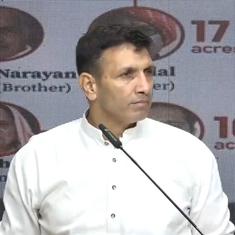
India and the United States could finalise a bilateral trade agreement by November, Union Commerce Minister Piyush Goyal said on Tuesday amid bilateral tensions over tariffs.
Goyal said he is hopeful that the two sides will “get back on track” to negotiate the trade deal despite “geopolitical issues”.
“We do hope to conclude a bilateral trade agreement by fall – November or so – as was discussed by our two leaders in February,” Goyal said while speaking virtually at the 21st Annual Global Investor Conference.
He acknowledged that “there is tremendous global turbulence and we are living in volatile, uncertain times, full of trepidations about the future”, but said that the Union government was working to strengthen the economy.
The commerce minister’s statement came a week after the 50% tariff rate on goods imported from India to the US took effect.
The Donald Trump administration had announced on August 6 that it would double the tariffs on Indian goods to 50% for purchasing Russian oil amid the Ukraine war. A 25% so-called reciprocal tariff had already taken effect.
The US president has repeatedly alleged that India’s imports were fuelling Russia’s war in Ukraine.
On Tuesday, Trump told reporters that the US “gets along with India very well but for many years it was a one-sided relationship”, ANI reported.
He repeated his accusations that India imposes excessively high tariffs on US products, pointing to American motorcycle maker Harley-Davidson as an example. He claimed that Harley-Davidson was pressured to set up a manufacturing plant in India in return for tariff concessions.
On Monday, Trump claimed in a social media post that India had “offered to cut their tariffs to nothing”, but added that “it’s getting late”.
Negotiators from both countries had completed a fifth round of talks in Washington in July. The next round, scheduled for August 25, was abruptly cancelled and no fresh dates have been announced as yet.
New Delhi had also previously said that it was “extremely unfortunate” that the US had chosen to impose additional tariffs on India “for actions that several other countries are also taking in their own national interest”.
